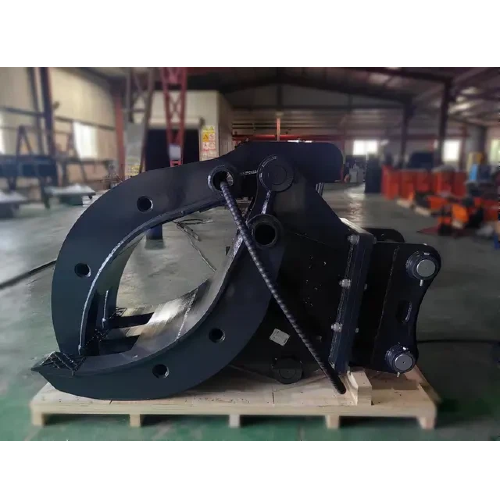
A hydraulic grapple is one of the most versatile attachments used on excavators, loaders, and other heavy-duty machinery. Designed to grip, lift, and move bulky materials with precision, it transforms the way operators handle construction debris, logs, scrap metal, and stones. But have you ever wondered how a hydraulic grapple actually works?
This article explains the working principle of a hydraulic grapple in depth—from its internal hydraulic mechanism and major components to its operation process, variations, and maintenance. Understanding this principle helps operators and equipment owners make better purchasing, usage, and maintenance decisions.
1. The Role of a Hydraulic Grapple
A hydraulic grapple is an excavator attachment powered by the machine’s hydraulic system. It uses hydraulic pressure to operate mechanical arms or jaws that can grip, lift, and release materials safely and efficiently.
Unlike mechanical grapples that rely on cables or linkages, hydraulic grapples provide greater power, precision, and flexibility, making them essential for:
Construction and demolition projects
Forestry and timber handling
Recycling and scrap metal sorting
Rock, stone, and waste management
Hydraulic grapples have become a key tool for modern earthmoving equipment because of their ability to combine hydraulic power and mechanical efficiency in one integrated system.
2. The Hydraulic System Behind the Grapple
The heart of every hydraulic grapple lies in its hydraulic system. This system converts the energy from pressurized fluid into mechanical motion. It operates based on Pascal’s Law, which states that pressure applied to a confined fluid is transmitted equally in all directions.
2.1 Basic Hydraulic Circuit
A simplified flow of how the system operates is shown below:
Component | Function |
Hydraulic Pump | Generates hydraulic pressure from the excavator engine |
Control Valve | Directs oil flow to the grapple’s cylinders |
Hydraulic Cylinder | Converts hydraulic pressure into linear mechanical force |
Grapple Arms | Open and close to grip materials |
Return Line | Returns oil to the tank for recirculation |
When the excavator operator moves the control lever, hydraulic oil is pressurized and sent through hoses to the grapple’s cylinders. These cylinders extend or retract, causing the jaws to open or close.
2.2 How the Hydraulic Circuit Works
Pump Activation – The excavator’s hydraulic pump generates high-pressure oil.
Flow Direction – The operator’s control input sends this oil through the control valve toward the grapple attachment.
Cylinder Movement – Oil enters the cylinder, moving the piston rod forward or backward.
Arm Motion – The motion of the cylinder is transferred through pivot points to move the grapple arms.
Return Flow – The used oil flows back through the return line, ready for another cycle.
This seamless process repeats in milliseconds, providing strong and responsive control during operation.
3. Key Components of a Hydraulic Grapple
To understand its working principle, we must examine its core components, each of which plays a vital role in ensuring precision and power.
3.1 Hydraulic Cylinders
These are the muscle of the grapple. Hydraulic cylinders receive pressurized fluid and extend or retract their piston rods, producing the gripping and releasing motion.
3.2 Grapple Arms (or Jaws)
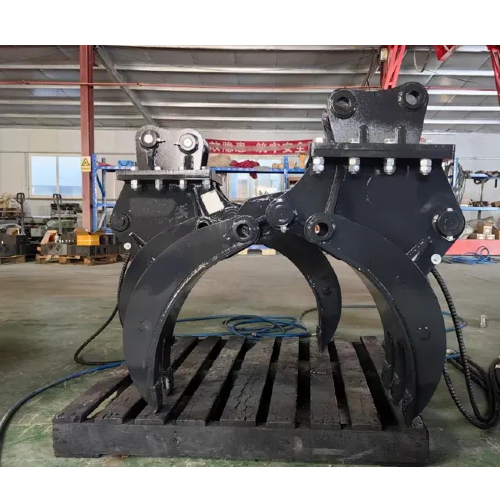
The arms physically contact the material. They are usually made of high-tensile steel and shaped to suit different materials—such as curved arms for logs or serrated jaws for stone.
3.3 Rotator (Optional)
Many modern hydraulic grapples feature a 360° hydraulic rotator, allowing the operator to rotate the grapple head in any direction for precise placement.
3.4 Pivot Points and Linkages
These transmit cylinder motion into arm movement, amplifying force and providing a stable structure for the grapple’s working cycle.
3.5 Hydraulic Hoses and Valves
Hoses transport pressurized oil, while valves control flow direction, pressure, and speed. Together, they form the circulatory system of the grapple.
4. The Working Principle of a Hydraulic Grapple
The working principle of a hydraulic grapple is based on converting hydraulic energy into mechanical motion through controlled pressure.
4.1 Step-by-Step Working Process
Stage | Description |
1. Pressure Generation | The excavator’s hydraulic pump generates pressurized oil. |
2. Flow Control | The operator manipulates the control valve to direct oil to the grapple. |
3. Cylinder Activation | Hydraulic oil enters the cylinder, pushing the piston rod. |
4. Arm Movement | The piston’s movement transfers to the grapple arms via pivot joints. |
5. Material Handling | The jaws close to grip or open to release materials. |
6. Pressure Release | When the control lever is neutral, oil returns to the tank for the next operation. |
In essence, the process can be summarized as:
Hydraulic Energy → Linear Cylinder Force → Arm Motion → Gripping Action
4.2 The Role of Hydraulic Pressure
The higher the hydraulic pressure, the greater the clamping force. Most excavator hydraulic grapples operate within a pressure range of 120–250 bar, depending on their size and application.
Proper matching between the excavator’s hydraulic flow rate and the grapple’s cylinder capacity ensures optimal efficiency and longer lifespan.
5. Variations of Hydraulic Grapples and Their Mechanisms
Different types of hydraulic grapples use the same principle but vary in structure and force distribution.
Type | Structure | Typical Use |
Single-Cylinder Grapple | One central cylinder operates both arms simultaneously. | Light-duty handling and sorting. |
Dual-Cylinder Grapple | Two independent cylinders for stronger, balanced grip. | Heavy demolition, rock, and scrap handling. |
Rotating Grapple | Equipped with 360° hydraulic rotator. | Precise material positioning and forestry work. |
Sorting or Multi-Purpose Grapple | Wider opening and reinforced arms. | Waste management and recycling centers. |
Each variant optimizes the hydraulic flow path and mechanical leverage to suit specific industries.
6. Advantages of Hydraulic Grapples
Hydraulic grapples outperform mechanical types due to their power efficiency and precision control.
6.1 Operational Advantages
High Gripping Force: Hydraulic pressure multiplies the excavator’s power output.
Smooth and Precise Movement: Controlled oil flow allows for accurate motion.
Versatility: Suitable for numerous industries and material types.
Durability: Built from wear-resistant steel and designed for heavy-duty use.
Safety: Reduces manual handling and workplace risks.
6.2 Productivity Benefits
Factor | Hydraulic Grapple Advantage |
Efficiency | Faster loading and unloading |
Cost-saving | Reduced fuel and labor cost |
Safety | Controlled motion, less operator risk |
Adaptability | Compatible with multiple excavator brands |
7. Hydraulic Efficiency and Energy Conversion
A well-designed hydraulic grapple achieves maximum energy transfer with minimal loss.
7.1 Hydraulic-to-Mechanical Conversion
The energy efficiency depends on:
Cylinder diameter and stroke
Hydraulic pressure stability
Friction at pivot points
Seal and hose integrity
The hydraulic system converts 80–90% of fluid energy into usable mechanical work if properly maintained.
7.2 Energy Equation (Simplified)
Force=Pressure×Piston Area\text{Force} = \text{Pressure} \times \text{Piston Area}Force=Pressure×Piston Area
For example, a hydraulic pressure of 180 bar (18,000 kPa) acting on a 0.002 m² piston area produces a force of 36 kN, enough to lift or crush heavy materials.
8. Maintenance to Preserve Working Efficiency
A hydraulic grapple’s performance depends heavily on regular care.
8.1 Daily Checks
Inspect hydraulic hoses and connectors for leaks.
Check for oil contamination or low levels.
Ensure pivot joints are lubricated.
Verify that pins and bushings are tight.
8.2 Scheduled Maintenance
Frequency | Task |
Weekly | Grease pivot points and rotator joints |
Monthly | Inspect cylinder seals and pressure settings |
Quarterly | Replace hydraulic oil filter |
Annually | Conduct full performance inspection |
Regular maintenance prevents system inefficiency, ensures safety, and prolongs the grapple’s lifespan.
9. Applications of Hydraulic Grapples Across Industries
Hydraulic grapples are indispensable in various sectors thanks to their versatility.
9.1 Construction and Demolition
Used to sort and remove concrete, debris, and steel structures efficiently.
9.2 Forestry
Timber grapples enable easy grabbing, stacking, and loading of logs without damaging bark.
9.3 Scrap and Recycling
Sorting grapples handle metal scraps, waste, and recyclable materials with precision.
9.4 Mining and Quarry
Powerful rock grapples manage boulders, stones, and uneven surfaces under tough conditions.
10. Troubleshooting the Hydraulic Grapple System
Even a well-maintained hydraulic grapple may encounter operational issues.
Problem | Possible Cause | Solution |
Weak gripping force | Low hydraulic pressure or worn seals | Check pump output and replace seals |
Slow movement | Blocked valve or hose | Clean hydraulic lines and filters |
Oil leakage | Damaged hose or fitting | Replace faulty parts immediately |
Uneven arm motion | Air in the system | Bleed air and refill hydraulic oil |
Addressing small issues early helps avoid costly downtime and major repairs.
11. Safety Considerations During Operation
Always confirm hydraulic connections are tight before operation.
Do not exceed the recommended working pressure.
Avoid sudden jerks or overloads during gripping.
Keep a safe distance between the grapple and nearby workers.
Shut off the hydraulic system before maintenance or attachment change.
12. The Future of Hydraulic Grapple Technology
Innovations in hydraulic technology continue to enhance grapple performance.
Smart control systems for precise oil flow management.
Lightweight alloys that reduce energy consumption.
Integrated sensors for pressure and temperature monitoring.
Eco-friendly hydraulic fluids that lower environmental impact.
Manufacturers like Yantai Rocka Machinery Co., Ltd. are driving these improvements with advanced design and manufacturing techniques.
13. Summary Table: Working Principle Overview
Process Stage | Description | Result |
Hydraulic pressure generation | Oil pressurized by excavator’s pump | Energy input created |
Cylinder activation | Oil drives piston rods | Converts pressure into motion |
Arm movement | Pivot system transfers force | Grapple opens or closes |
Material handling | Jaws grip or release materials | Work performed |
Return flow | Oil returns to tank | System resets for next cycle |
This table summarizes the complete hydraulic grapple working cycle, emphasizing how hydraulic power drives mechanical precision.
14. Conclusion
The working principle of a hydraulic grapple centers on the controlled conversion of hydraulic pressure into gripping motion. Through hydraulic cylinders, pivot linkages, and precision valves, the grapple achieves powerful and precise handling performance across industries like construction, forestry, and recycling.
Understanding this principle not only helps operators use the equipment more efficiently but also aids buyers in selecting grapples that match their excavator’s hydraulic system and work requirements.
For those seeking reliable, high-performance hydraulic grapples, it’s worth exploring the expertise of Yantai Rocka Machinery Co., Ltd. — a professional manufacturer offering durable, customizable, and efficient excavator attachments.


